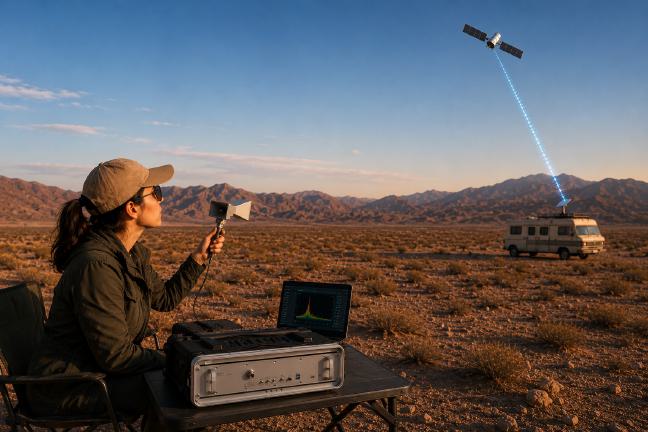

Effective area and border security demands the ability to detect, classify and precisely geolocate RF emitters across a wide frequency range, in real time, 24 hours a day, without constant human supervision. It demands intelligence, not just observation.
The cognitelligent systems from YOTASYS address this challenge directly. The Y9827A Inceptron Spectrum Analyzer combines the proven RF measurement performance of an Anritsu MS27201A spectrum analyzer with embedded NVIDIA Jetson Orin NX edge AI processing, TDOA/POA passive geolocation, LSTM-based anomaly detection and an agentic AI control layer: a fully autonomous RF monitoring platform designed for the most demanding field and infrastructure deployments.
The system continuously monitors the radio spectrum from 9 kHz to 54 GHz, covering every communication band border threat actors use: VHF/UHF PMR radios, mobile networks (2G to 5G), Wi-Fi, Bluetooth, LoRa, ISM devices and drone control links. Several Y9827A units can be networked as a passive sensor array that geolocates active RF emitters by Time Difference of Arrival (TDOA), pinpointing a transmitter’s position on a map without any cooperative signal from the target.
The Y9827A Inceptron Spectrum Analyzer
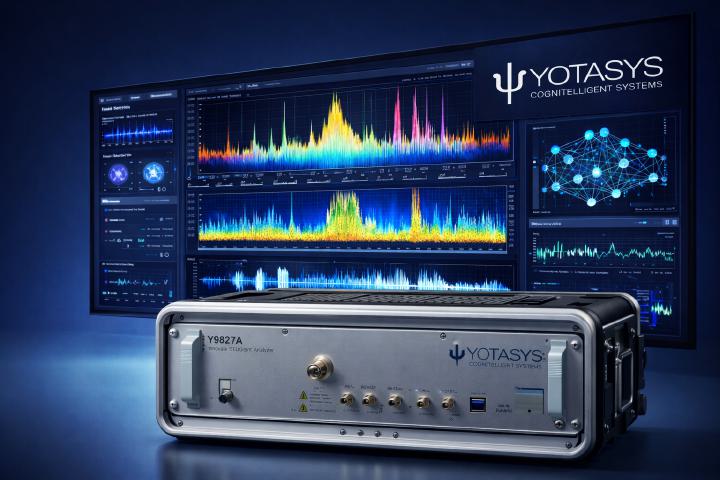
The Y9827A Inceptron is a rack-mounted, full-spectrum RF monitoring instrument designed for continuous, unattended operation in demanding field and infrastructure environments. Its stacked architecture combines the proven RF front end of the Anritsu MS27201A with YOTASYS Inceptron Technology™: an integrated NVIDIA Jetson Orin NX processor running Ubuntu Linux, Node-RED, ONNX inference libraries and the full Y9800A software suite.
At its computational core, the NVIDIA Jetson Orin NX GPU module delivers 157 TOPS (INT8) of AI inference performance in a power-efficient, thermally optimized form factor. This brings cloud-class neural network processing directly to the field sensor, without the latency, bandwidth consumption and data security risks of remote server or cloud-based AI. CNN inference, LSTM anomaly scoring and TDOA cross-correlation all run locally, in under one millisecond per analysis cycle.
Agentic AI: the intelligent operator
The most significant innovation in the Y9827A is its agentic AI layer: a Large Language Model (LLM) that acts as an intelligent co-analyst, accepting natural-language instructions, orchestrating instrument control and turning results into structured operational reports.
Traditional spectrum analyzers require operators to navigate complex menus and write precise SCPI command sequences, a knowledge barrier only experienced RF engineers can cross. The agentic AI removes this barrier entirely. An operator types a plain-language directive such as “Scan the 380–400 MHz PMR band and identify any non-standard emitters”, and the system configures the analyzer, captures IQ data, runs the CNN classifier, computes a TDOA position fix when several nodes are available, and returns a readable report with geolocation coordinates, in under 30 seconds.
The agentic architecture works with locally hosted LLMs for fully air-gapped, classified environments, meeting the data security requirements of government and defense customers.
AI signal classification: CNN-based recognition
At the core of the Y9827A’s signal intelligence is a Convolutional Neural Network (CNN) that processes RF signals as spectral images or time-frequency representations, recognizing the unique characteristics of each signal type, even in congested, low-SNR environments. The CNN identifies modulation schemes, protocol-specific patterns, device-specific RF hardware fingerprints, drone RF signatures and anomalous emissions that deviate from expected signal profiles.
Classification models are delivered as software library modules under the Y9800A designation, covering modulation analysis, drone and pilot detection, jammer detection, mobile network identification, IoT/ISM band devices and more. Custom models can be trained with the YOTASYS Y9900A Training System, so organizations can develop proprietary CNN models from their own captured signal environments.
TDOA/POA geolocation and hybrid fusion
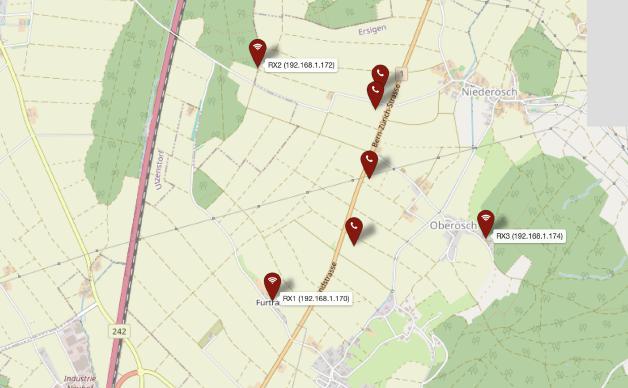
Time Difference of Arrival (TDOA) geolocation is the most accurate passive positioning method available for RF emitters. A transmitted signal arrives at spatially separated Y9827A receivers at slightly different times. Each pair of receivers yields a TDOA measurement that defines a hyperbolic locus of possible transmitter positions; with three or more receivers, the hyperbolas intersect and pinpoint the transmitter in two or three dimensions.
At the nominal 200 MSPS operating point, the timestamped IQ stream provides a 5 ns timing grid. Sub-sample interpolation by correlation achieves an effective timing resolution of 0.25–0.5 ns at an SNR above 15 dB, equivalent to 8–15 cm range resolution, using only the GPS timestamp of the IQ data for synchronization. For the most demanding applications, White Rabbit PTP synchronization (below 1 ns between nodes) is supported, enabling centimeter-level positioning with 5G NR waveforms.
For narrowband signals or single-receiver deployments, where TDOA precision is limited, Power-of-Arrival (POA) geolocation adds a complementary capability with 50–500 m accuracy. The YOTASYS platform uses a minimum-variance hybrid fusion architecture that adaptively combines TDOA and POA estimates in real time, as a function of signal bandwidth, synchronization quality and measured SNR, always delivering the best position fix the available data allows.
LSTM anomaly detection: pattern-of-life intelligence
Beyond classifying individual signals, effective border monitoring requires knowing what is normal in a given RF environment, and detecting at once when something deviates. Long Short-Term Memory (LSTM) neural networks continuously analyze the time-evolving spectrum occupancy of a monitored area, building a robust statistical model of normal RF behavior, the “pattern of life”, and raising alerts when observed activity diverges from this learned baseline.
Unlike threshold-based monitors, which generate excessive false alarms and miss low-and-slow anomalies, YOTASYS LSTM models flag deviations regardless of absolute signal level. A signal 10 dB below the noise floor that arrives at an unexpected time or frequency is detected because it deviates from the learned temporal pattern. Initial training takes 24 to 72 hours to establish the site-specific baseline; the model then keeps updating in the background.
Node-RED programmability
The Y9827A comes with Node-RED and the full YOTASYS Y9800A library of instrument control, spectrum acquisition and AI inference nodes pre-installed. Operators build, modify and deploy sophisticated surveillance workflows visually, without specialist software engineering skills. Example border security workflows:
- Spectrum scan → CNN inference → TDOA positioning → MQTT alert to C2 → map update
- Jammer detection → LSTM anomaly flag → operator alert with frequency, bearing and estimated EIRP, with multi-node TDOA network coordination and KML position output to GIS platforms
Integration with external systems is supported via MQTT, REST API, KML/GeoJSON, ASTERIX, SNMP and TCP/IP, so the Y9827A can take part in broader C2 networks and Common Operating Picture (COP) environments.