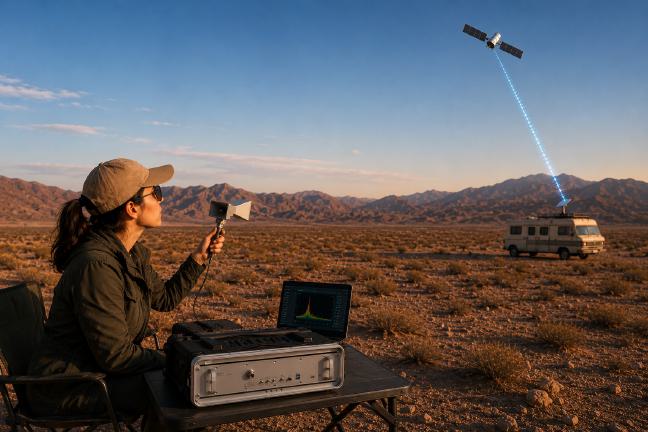

The proliferation of wireless communication standards, from legacy analog systems to modern digital and adaptive protocols such as 5G, satellite links and software-defined radios, has made traditional analysis methods insufficient for the speed and complexity of contemporary threat scenarios.
Artificial intelligence (AI) algorithms have emerged as a decisive enabler for modern, broad-spectrum analysis. Using machine learning, deep learning and advanced pattern recognition, AI can ingest massive volumes of raw RF data from across the spectrum, automatically detect signals of interest, and classify their modulation, source and potential intent. These systems handle both narrowband and wideband data, covering all known wireless standards while adapting to unknown or non-standard waveforms.
A critical advantage of AI-powered spectrum analysis is real-time processing. Traditional workflows often relied on post-event analysis, which limited operational responsiveness. AI-enabled EW/SIGINT platforms now process high-throughput data streams instantly, giving operators immediate alerts on anomalies, jamming attempts or emerging hostile transmissions. This real-time situational awareness accelerates the detection–classification–decision cycle and makes missions more effective in contested environments.
These advances have led to cognitelligent solutions: systems that combine cognitive computing with intelligent automation. They support human operators by filtering out irrelevant data, highlighting critical threats and recommending decisions based on learned patterns and the mission context. By reducing cognitive load and increasing confidence in the data, AI enables faster, better-informed human decisions, a decisive factor in time-critical defense scenarios.
On the modern battlefield, superiority in the electromagnetic spectrum hinges on speed, adaptability and precision. AI algorithms integrated into EW and SIGINT platforms deliver all three, turning the vast complexity of wireless communications into actionable intelligence at machine speed. The result is a force multiplier that reshapes the tempo and outcome of military and security operations.
Use cases for cognitive RF signal analysis
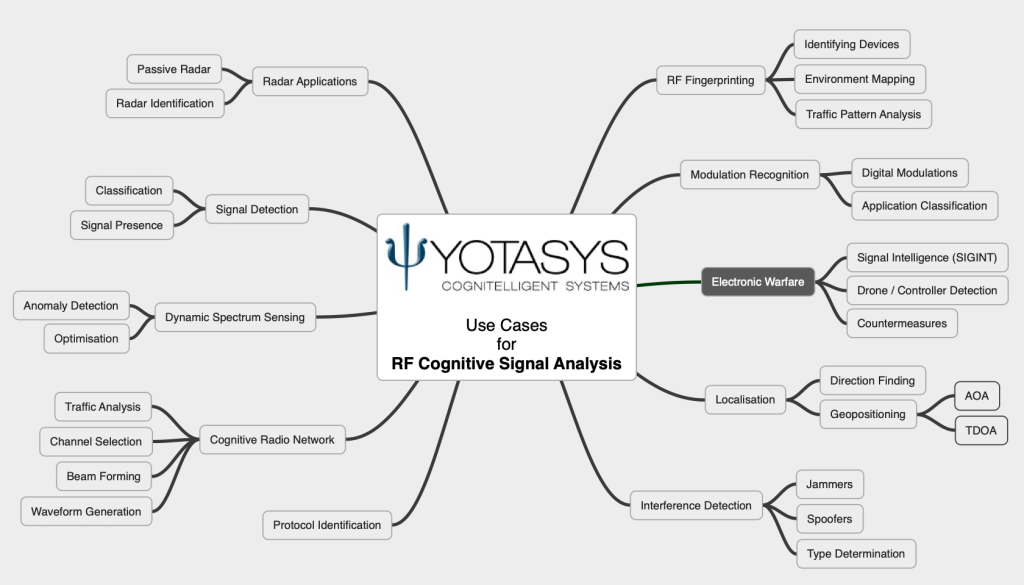
In contemporary EW and SIGINT, artificial intelligence has shifted the operational model from reactive analysis to proactive, adaptive engagement. Modern AI systems use deep learning, pattern recognition and anomaly detection to process vast amounts of RF data in real time, identifying known and unknown signals across the entire electromagnetic spectrum.
The Y9860A AI-enabled Real-Time Spectrum Analyzer (RTSA)
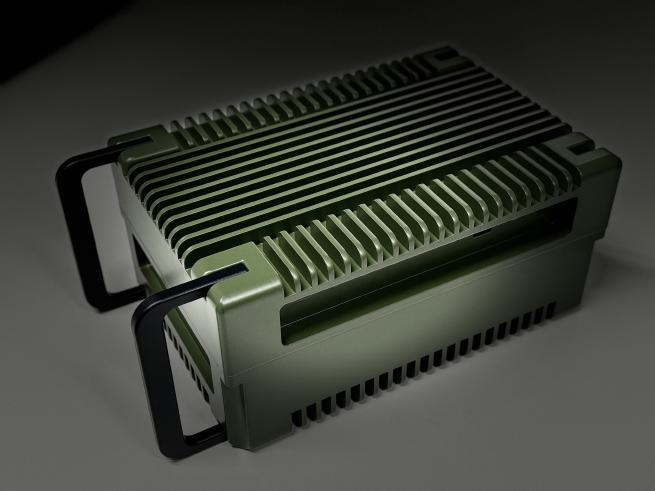
The Y9860A is high-performance, state-of-the-art hardware for AI algorithm processing and deep-learning inference, developed to work with a modern spectrum analyzer board, the Anritsu MS27200A, over a high-performance link. Its embedded graphics processing unit (CPU/GPU) runs real-time neural-network signal processing (CNN) algorithms in software, with room for additional, specialized signal analysis development.
The GPU is one of the most widely used processor types for machine learning, so the Y9860A significantly reduces the effort for developers to create autonomous signal identification, modulation recognition, interference mitigation and many other machine-learning applications for RF technologies. It analyzes an RF signal source and can also generate IQ data files and reports. Thanks to the AI capabilities of the integrated software, RF signals can be inspected in a sophisticated, modern way.
In one single box, the Y9860A includes numerous functions, such as interference recognition, and open-source APIs. The system comes with complete software packages and is based on the Linux Ubuntu operating system, with drivers, FPGA firmware and everything required for professional operation. It is the base for customer-specific software development.
The YOTASYS Y9860A is an innovative, modern solution for a high-performance portable setup to capture, analyze and report RF signals. Based on the IQ streaming of the MS27200A, it extends RF measurement and investigation up to 9 GHz (or higher), with unique features for detecting and analyzing unknown or unwanted signals.
A single Y9860A sensor can cover a wide geographical area and monitor it for suspicious wireless signal activity.
This approach enables applications such as automatic modulation recognition, detection of low-probability-of-intercept transmissions, spectrum occupancy mapping and adaptive countermeasure planning.
By integrating cognitive filtering and mission-context awareness, AI platforms separate critical intelligence from background noise, dramatically reducing operator workload. The result is a faster detect–classify–respond cycle: cognitelligent solutions, where machine-speed analysis supports human decision-making in the most demanding spectrum environments.
Easy graphical user interface
The Y9860A software is flexible and modular, and can be tailored to customer-specific needs. YOTASYS also develops customer-specific software and tools for fast prototyping and installation.
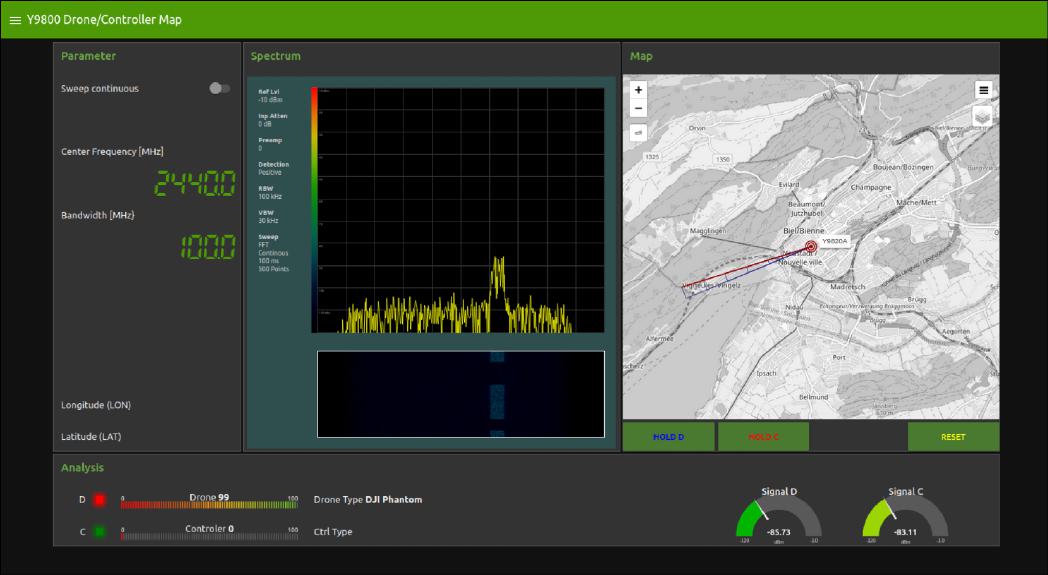
A web interface lets the end user operate and configure the Y9860A, with a comprehensive, application-specific dashboard of charts, buttons, status LEDs and map information.
For drone and controller detection, the system tells apart even multiplexed and similar signals, which can then be used to locate the emitters geographically.
The Y9860A integrates easily into existing radio monitoring solutions. Alarms can be tailored to specific interfaces such as HTTP, MQTT or SNMP.